Last checked: 9 November 2026. Fees and deadlines change every year, so every row below links back to the organiser and shows when we last looked.
Disclosure: Search ‘n Stuff publishes this guide and ran its own first awards programme in 2026. We’ve listed it in the calendar like every other programme and described it in a short section near the end, with the same caveats we apply to everyone else. We have no commercial relationship with any other organiser named here.
The quick answer
If you work in the UK, the UK Search Awards remains the best-known search-specific programme, with the European and Global Search Awards as its regional and international siblings. US teams usually look at the US Search Awards or the Search Engine Land Awards. Before entering any of them, price in the fee, VAT, the table and the hours of writing, and only enter work you can prove with numbers.
The search awards calendar
Most programmes haven’t published 2027 dates yet, so the table shows the most recent cycle. Treat it as a guide to timing and price: deadlines usually land within a couple of weeks of the same point each year. Fees are per entry and exclude VAT unless stated.
| Programme | Organiser | Region | Entry fee (latest cycle) | Final deadline (latest cycle) | Ceremony | Best for | Checked |
|---|---|---|---|---|---|---|---|
| UK Search Awards | Don’t Panic Events | UK | £220 super early bird, £275 early bird, £365 final | 17 Sep 2026 | 25 Nov 2026, Troxy, London | UK agencies and in-house teams | 9 Nov 2026 (official) |
| European Search Awards | Don’t Panic Events | Europe | £220 / £275 / £365 | 26 Feb 2026 (extended) | 20 May 2026, Porto (Vila Nova de Gaia). 2027 edition reported for 12 May* | Pan-European and multi-market work | 9 Nov 2026 (official; 2027 date secondary) |
| Global Search Awards | Don’t Panic Events | Worldwide | £220 / £275 / £365 | 28 May 2026 | 23 Sep 2026, Mansion House, Dublin | International campaigns and tools | 9 Nov 2026 (official) |
| US Search Awards | Don’t Panic Events | USA | $300 / $375 / $495 | 16 Jul 2026 | Reported for 7 Oct 2026, New York* | US agencies and brands | 9 Nov 2026 (fees official; ceremony secondary) |
| APAC Search Awards | Don’t Panic Events | Asia-Pacific | £170 / £230 / £290 | 22 Oct 2026 | Reported for 11 Feb 2027* | Teams working across APAC markets | 9 Nov 2026 (fees official; ceremony secondary) |
| MENA Search Awards | Don’t Panic Events | Middle East and North Africa | Reported as $300 to $495* | Check organiser | Reported for 11 Nov 2026, virtual* | Teams in Gulf and wider MENA markets | Secondary only |
| Search Engine Land Awards | Search Engine Land (owned by Semrush) | Worldwide, English entries | $395 / $495 / $595 | 4 Sep 2026 | No ceremony: finalists 19 Oct, winners 26 Oct 2026 | Teams who want recognition without travel | 9 Nov 2026 (official) |
| The Drum Awards for Media (search categories) | The Drum | UK / global | Reported as £495 to £714* | Check organiser | Reported for 30 Nov to 3 Dec 2026, London* | Media agencies with search inside a wider plan | Secondary only |
| Performance Marketing Awards | Haymarket | UK | £395 to £695, rising by deadline | 13 Feb 2026 | London (spring) | Paid search and performance teams | Secondary |
| Friends of Search Awards | DDMA / Friends of Search | Netherlands | Check organiser | Check organiser | 12 Mar 2026, Amsterdam | Dutch and Benelux SEO and PPC teams | Secondary |
| Search & Discovery Awards | Boussias | Greece | Check organiser | Check organiser | 15 Apr 2026 | Greek market | Secondary |
| Northern Digital Awards | Prolific North | North of England | £150 / £185 / £245 | Check organiser | Manchester | Northern agencies and freelancers | Secondary |
| Search ‘n Stuff Awards | Search ‘n Stuff (publisher of this guide) | UK / international | Free for conference ticket holders and in-house brand teams; €300 awards pass for others | 10 Sep 2026 | 3 Oct 2026, Antalya (first edition) | Teams who want to present their work live to peers | 9 Nov 2026 (own programme) |
* Reported by secondary sources and not yet confirmed on the organiser’s own site.
Sources for Don’t Panic Events fees and deadlines (official Help & FAQs pages, checked 9 November 2026): UK Search Awards, European Search Awards, Global Search Awards, US Search Awards, APAC Search Awards, MENA Search Awards.
A few programmes sit just outside the search-specific circuit but are worth knowing about. The National Digital Awards include a PPC Campaign of the Year category. The UK Agency Awards and UK Digital Excellence Awards reward agencies and digital teams more broadly, and strong search work can carry an entry. The Shorty Awards added a generative engine optimisation (GEO) category, with its first winner announced in 2026. The Semrush AI Visibility Awards, launched in December 2025, work differently: there are no entries, and recognition is based on Semrush’s own visibility data.
Some names you may find in older articles no longer run as separate events. The Drum’s standalone Search Awards appear to have been folded into its wider media awards after the 2023 edition, and the Semrush-backed Australian Search Awards and Canadian Search Awards ran for only a handful of years around 2018 to 2021.
Which award fits you?
Agencies get the most from the Don’t Panic circuit. The UK Search Awards shortlist is widely recognised by UK clients and prospects, and the format, a 1,000-word entry judged in two stages, rewards agencies that already document results for clients. If your clients are spread across several countries, the European or Global Search Awards let you enter that work as a whole rather than chopping it into national pieces.
In-house teams should think about who the badge is for. If it is for the leadership team, a programme with a business-results category and a respected judging panel matters more than a big ceremony. The Search Engine Land Awards suit teams that can’t justify travel, and regional programmes such as Friends of Search or Search & Discovery carry real weight inside their own markets.
Freelancers and very small teams face the hardest maths, because fees, VAT, a seat at the ceremony and travel can quickly pass a month’s income. Look first at programmes with freelancer or small-business categories, regional awards with lower fees, or free-to-enter programmes. Entering one award well is better than entering three badly.
What entering really costs
The entry fee is the number everyone sees, but it is rarely the biggest cost. Here is a worked example for a UK agency entering three campaigns into the UK Search Awards, using the 2026 fees.
| Super early bird | Final deadline | |
|---|---|---|
| 3 entries | 3 × £220 = £660 | 3 × £365 = £1,095 |
| VAT at 20% | £132 | £219 |
| Total fees | £792 | £1,314 |
Simply entering early saves £522 on three entries. Then add the costs that don’t appear on the entry form: ceremony tickets or a table if you are shortlisted (check each organiser’s current price), travel and hotel for anyone who isn’t local, and time. Our own assumption, not an organiser figure, is that a strong entry takes somewhere between one and three working days once you count pulling data, getting client sign-off and rewriting to the word limit. Price that time at your day rate and the real cost of three entries can easily be several times the fee.
How judging works
Most programmes use a panel of practitioners who score entries against published criteria. The Don’t Panic awards use a two-stage process: judges pre-score entries to set the shortlist, then meet in panels to discuss and decide the winners. Read the criteria for your category before you write a word, because judges score against them, not against how impressive the campaign felt at the time.
Ask three questions about any programme. Who are the judges, and are they named? How are conflicts of interest handled when a judge’s employer or client has entered? And what share of the score goes to measurable results compared with strategy and creativity? A programme that can answer all three openly is usually one whose badge means something.
The case against entering
Awards are not for everyone, and it is worth being honest about why. Entry is pay-to-play: the shortlist only includes work from those who paid, so a trophy tells you who entered well, not who did the best work in the industry. Fees and table prices add up across several programmes, and the time spent writing entries is time not spent on clients. Some teams also find that clients care far more about a clear case study on the agency’s own site than about a logo in the footer.
If the main goal is new business, compare the full cost of an awards campaign with what the same money and hours would buy in published case studies, speaking slots or digital PR. Enter when you have work you’re proud of and evidence to back it up, not because a competitor did.
AI search categories
The biggest change in recent cycles is the arrival of categories for AI search and generative engine optimisation. Judges are still working out what good evidence looks like here, so the strongest entries tend to explain clearly how visibility in AI answers was measured, which tools were used, what the baseline was and how the change links to traffic, leads or revenue. Screenshots of a single AI answer are not enough on their own. Treat it like any other search entry: a clear problem, a method someone else could repeat, and results with dates.
Write an entry that doubles as a case study
The best entries are useful long after the ceremony. Structure yours around the challenge, the strategy, the execution and the results, with dates and before-and-after figures for every claim. Get client approval for the numbers before you start writing, not the night before the deadline. Once it’s written, you have most of a published case study, a sales deck slide and a conference talk, whether or not you win.
A simple test: could a judge who has never heard of the client understand what changed, why it mattered and how you know your work caused it? If yes, it’s ready.
For brands: how to read an awards badge
If you’re choosing an agency, an awards badge is a reasonable starting point, but not proof on its own. Check which programme it came from, whether it was a win or a shortlist, which year and which category. Then ask the agency for the entry or the case study behind it, and for a reference from that client. A recent shortlist in a category that matches your problem tells you more than an old win in an unrelated one.
The Search ‘n Stuff Awards
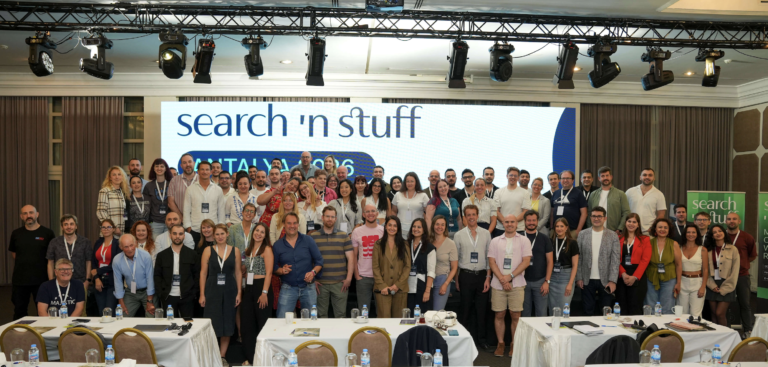
Search ‘n Stuff, the community and events brand that publishes this guide, ran its first awards in 2026. The awards were held as part of the Search ‘n Stuff Antalya conference, with a gala night on 3 October 2026, and covered four areas: SEO growth strategy, performance marketing strategy, analytics and measurement, and AI visibility strategy in search. Entry was free for conference ticket holders and in-house brand teams, with a paid awards pass for others. A jury of practitioners scored the entries and shortlisted finalists, who then presented their cases live on stage. Winners were decided by a 50/50 combination of jury scores and audience votes, and jury members declared conflicts of interest and stayed out of any category where they had one.
It is a young programme and doesn’t yet have the history of the established awards above. It was designed as a way for practitioners to share real case studies within the community rather than as a rival to the established programmes, and details of the 2027 edition will be published on the Search ‘n Stuff website.
Frequently asked questions
What are the main search awards?
The best-known search-specific programmes are the UK, European, Global, US, APAC and MENA Search Awards run by Don’t Panic Events, and the Search Engine Land Awards. Broader marketing awards such as The Drum Awards for Media and the Performance Marketing Awards also include search categories.
How much does it cost to enter the UK Search Awards?
In 2026, entries cost £220 plus VAT at the super early bird deadline, £275 at the early bird deadline and £365 at the final deadline, per entry. Ceremony tickets are separate.
When is the UK Search Awards 2026 ceremony?
The 2026 ceremony takes place on 25 November 2026 at Troxy in London.
Are search awards worth it?
They can be, if you have well-evidenced work and a clear use for the result, such as winning new clients or recognising a team. They are less useful if the cost would stretch your budget or if you’d only be entering to match a competitor.
Can freelancers enter search awards?
Yes. Many programmes accept entries from freelancers and some have dedicated categories. Check each programme’s eligibility rules and look at regional or free-to-enter awards where the fees are easier to justify.
Are there awards for AI search or GEO?
Yes. Several programmes now include AI search or generative engine optimisation categories, and the Shorty Awards named its first GEO winner in 2026. Strong entries show how AI visibility was measured and how it links to business results.
Planning your events year as well? See our guide to the top SEO conferences to attend.